Eduardo Graue
I´m from Mexico City.
I travel through some countries in Europe time ago, working as a migrant with people of diferent nacionalities.
I also travel from painting to jewellery when I remember I like to do toys, as in the beginig.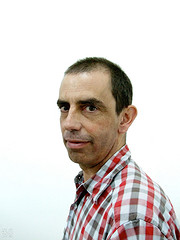
Now I prefer to live in the border of this two subjects because of the plenty of sources to exchange.
Hello Carolina Vallejo.
I feel emotion that we could exchange: perceptions,ideas ,creations and expres our selfs . Also I´m trying to learn how to use all this way of exchange.
for the moment good greetings
Eduardo Graue
Hola Carolina.
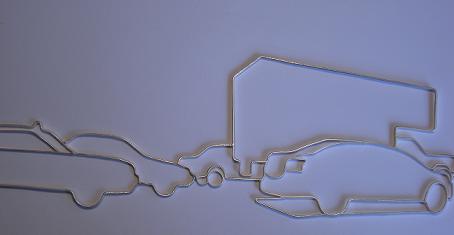
Te mando estas fotos que tome ayer viajando en la calle.
Mé gusta recolectar deliciosas lineas externas de las siluetas de los coches que se entremezclan en el tráfico como fronteras que se fusionan.Coches fabricados para correr sobre la; sin brillo gris supeficie, cada uno hace un pequeño dominio dentro de las calles y avenidas de esta ciudad . Eso me incomoda. Sus brillos y colores me atraen ,pero en este momento, el interes principal es el continuo contorno fusionado que salta de ,parabrisas cofre cajuela puerta luz defensa , uniendose con algunas lineas.
Te desoe lo mejor y te mando colurosos saludos. Eduardo.
Hello Carolina.
I send you this fotos 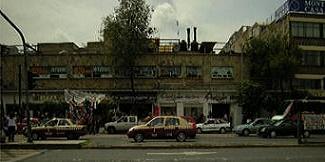 that I took yesterday traveling in the street. that I took yesterday traveling in the street.
I like to recolect delicious outlines of the silhouettes of the cars that intermingle in the traffic as frontiers that joint together .Cars made to run upon the ; with out shine gray surface ,each one makes a little domain inside the streets and avenues of the city. That makes my uncomfortable . Their polish and colors attract my, but my principal interest now is in that continous fusing contourns that goes , windscreen front back door ligth defense ,joint together with some lines.
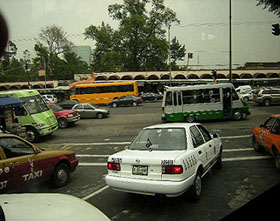
I wish you the best and send
warm greetings. Eduardo
It will be a pleasure collaborating with you on the theme of immigration. In my life I have been in contact change of place and environment.
You are living in one of the largest cities of the world, and I am living in one of the smallest countries of the world.
I feel we would benefit by sending small (inexpensive) objects by post, but I also still need to find out how to post photos.
How would you like to proceed? Cars? Is that because there are more than a million cars running through your city constantly?
ANTECEDENTES It will be a pleasure collaborating with you on the theme of immigration. In my life I have been in contact change of place and environment.
You are living in one of the largest cities of the world, and I am living in one of the smallest countries of the world.
I feel we would benefit by sending small (inexpensive) objects by post, but I also still need to find out how to post photos.
How would you like to proceed? Cars? Is that because there are more than a million cars running through your city constantly?
Eduardo Graue
Que gusto leer tu correo Carolina, me a pena no haberte podido responder mas rápido, hubo algunos inconvenientes que me lo impidieron,disculpa.
Me parece que va a ser muy agradable intercambiar visiones tan diferentes desde lugares tan distintos.
¿Cuéntame tus inquietudes? Estoy interesado en saber que ideas tienes al respecto.
Tal vez para proceder tendremos que platicar más sobre nuestras ideas
Sobre los coches últimamente mi atención ha ido en aumento. Inicialmente hice otros trabajos en pintura como una serie, en donde pretendía representar el orden formal de escenas cotidianas del tránsito de la ciudad de México. Situación subjetiva por la gran cantidad de variables y su desconexión entre ellas.
Sin embargo, al aterrizar en otro medio como la joyería, en algún sentido mas tridimensional, muy específico en relación al cuerpo, diferente en muchos aspectos con la pintura, reapareció este tránsito en la Ciudad de México, adquiriendo un carácter muy diferente, mas narrativo y dibujistico en su manera, aun supeditado a la representación, que me atrajo por la situación de juego que establece con el cuerpo, al ser virtualmente recorrido como relieve geográfico. Desde luego que es una idea simple, pero me llevo a pensar en diferentes posibilidades al respecto de los problemas en cuestión. En estos procesos mucho queda en la basura y también como experiencia.
Tal vez cada disciplina implícita dentro de este intercambio tendrá su parte: el Oficio, el Diseño, y el Arte. En algunos aspectos desde la intención subjetiva no racional o luego el punto intermedio entre función y lo estético, al final, lo primero, la idea central precisa desde de lo indefinido.
Lo que menciona sobre podernos beneficiar mandando pequeños objetos (no caros) enviados por correo suena bien, seria bueno especificar: el como y las ideas.
Hasta pronto Carolina. Calurosos Saludos Eduardo.
I am glad to read your post Carolina, I feel embarrass that this answer was not send sooner but there were troubles that obstruct me, sorry .
I think it will be very pleasant to exchange so diverse visions and from different places.
Tell me about what you search for; I am interest in know what ideas you have on this matter
Maybe to proceed, we have to talk more about our ideas and define.
About the cars, my attention increases recently. Initially I had done other works in painting as a series, on which I pretend to represent the formal order of daily Mexico City transit.
Subjective situation because of the large quantity of variables and disconnection between them
However, when I land in the medium of jewelry, which in a way is: three-dimensional, very specifically related to the body, different in many aspects to painting, reappear Mexico City transit scenes, on which the result character was different, also linked with representation, more narrative drawing manner in a way related to the employed elements. This atract me because of the playing situation that establish with the body, run through virtually as a geographic relief. Of course, that is a simple idea, but it takes me to think in different possibilities about the problems in question.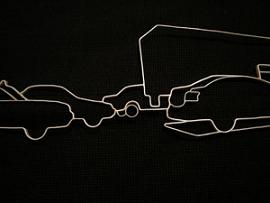
In this process, many things are gone into the garbage can, and taken as experience.
Maybe each discipline include into this exchange has its own part: Crafts, Design, and Art. In some cases the subjective no rational intention or then at the middle point between function an esthetics, at the end, the first, the central precise idea from the indefinite.
What you mention about we would benefit by sending small (inexpensive) objects by post, sounds well, it will be right to define how an also the ideas.
See you soon Carolina. Warm greetings, Eduardo
Eduardo Graue
Hello Carolina. This is a more clear foto related with the jewellry work.
Can it be another mapamundi shape
Today is a little bit colder , because of the entrance of an
hurriccane name “Rick” that arraives from the Pacific Ocean
With best wishes, Eduardo
Eduardo Graue
La semana pasada, recordé que en una ocasión en otra casa donde vivía, durante algún tiempo comenzó a oler como a gasolina o gas. Dicho olor provenía de un patio exterior que se usaba como bodega. Por querer saber la causa, comencé a mover objetos almacenados y encontré un gato ya muy alineado al piso. La operación siguiente iba a ser difícil y escabrosa. Como de costumbre tratar de contenerlo todo en un recipiente, bolsa de plástico, bote de basura, eliminar cualquier mínima partícula hasta las que provocan el aroma. Me quede impresionado al encontrar dentro de este conjunto otro animal nunca antes visto. Como de 2.5cm de largo, ovalado, muy negro y con manchas naranjas muy llamativas repartidas simétricamente en los caparazones de sus alas. De chico a veces jugaba con unos parecidos, que desde el mes de Junio se aparecían en las flores del parque por donde vivía. Este me impresiono por sus contrastes, y el lugar en donde estaba, le tuve miedo, lo vi durante algún tiempo con repulsión, respeto y luego, todo se fue al bote de basura.
En una segunda ocasión, pasando las hojas de un libro sobre coleópteros, lo volví a ver nuevamente. Este segundo encuentro me hizo entender, que la primera vez había sido muy especial. Este insecto es muy sigiloso y solo vuela de noche , con hábitos muy peculiares, porque al salir busca la materia útil para primero depredar en ella larvas de otros insectos y posteriormente por debajo de esta ,escarbar galerías profundas al fondo de las cuales arrastra la materia encontrada y con su pelo o plumas ( elige mamíferos y aves pequeños) forma un nido profundo y aislado evitando la depredación de sus futuros hijos a los que cuida durante un tiempo y que mas adelante vuelan para reproducirse repitiendo el ciclo. Escarabajo Enterradores “Necrophorus marginatus”
Después de observarlo detenidamente durante algún tiempo, recordé que en ese patio, el piso era de cemento y esto nos habia cambiado , al muy especial y respetable “Necrophorus” y a nosotros por causa de la ciudad, el juego
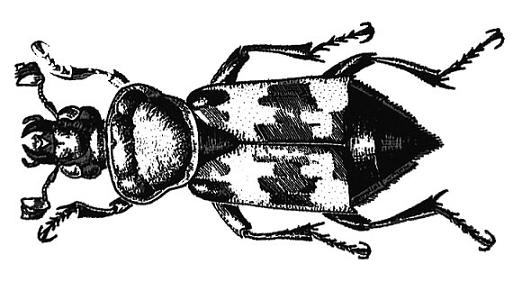
I remember last week that in some occasion in other house where I live, during some time, start a smell like gasoline or gas. This smell belongs from an exterior courtyard that was used as a storeroom. Wishing to now the cause, I start moving stored objects and found a cat sow very aligned as the floor. The next operation that comes ,was harsh and difficult. As the custom is, tried to contain all in a recipient, plastic bag, can, eliminate every particle even the ones who produce the aroma. I was impressed to find inside this united ,another animal never seen before. Very black, about 2.5cm large, elliptical with very flashy orange spots shared symmetrically on the covering shells of their wings. When i was younger ,I use to play with a similar kind that appears on June in the flowers of the park near where I live. This one shocks me because of their contrasts an the place where he was. I feel scare at him, I stay looking with repulsion, respect, and then all goes into the garbage can.
In a second occasion, turning the pages of a book about coleopteros I meet him again. This second encounter makes me understand that the first time was very special. This insect is very cautious and only flies at night, with very particular habits because when he goes out, search the raw material for first predate on it warms of other insects and then scratch in the ground below, for drag all this stuff ,into deep galleries , on the bottom of which also forms with feathers or hair (he choose small mammals or birds) a deep nest to keep the new sons apart of depredation and protect them until they fly for reproduction an continue the cycle. Bury beetle is his name “Necrophorus marginatus”
After looking at him carefully, I remember that the floor of that courtyard where I saw him first, was of cement and this had change use , the very special and respectful” Necrophorus” and we because of the city , the game
Dear Eduardo,
How are you? As we know Carolina passed the baton to me and we will be partners now in this project. I am glad to be part of WGA and I think it will be nice meeting you here for the months to come. My name is Peter and I live in Amsterdam where I have been living since 1983. Talking about migration:
-Apart from living a year in the south of Germany during my studies I have been living in the Netherlands all my life. First in Leiden, where I grew up, then in The Hague and presently Amsterdam. I like this city very much, it is more of a large town in my opinion. Although it lacks the grandeur of the cities and capitals of most other European countries, there is a lot to see and do here, also culturally. The atmosphere is quite liberal, something I really missed living in the south of Germany.
-I really love traveling and whenever I get the chance I am in a plane to some distant (or closer) destination. Without exception I am moving from one place to the other during my holidays, usually taking the normal busses, trains, boats or whatever means of transport available in that part of the world. Every day is different, new impressions all the time. Just love traveling, including the hardships of it sometimes. I feel fortunate I was born in that generation for which traveling to far away countries has come within reasonable reach. Today I am surprised sometimes by the number of teenagers and adolescents that travel the world nowadays and which you meet at the other end of the world. During the last three decades I have really seen that number going up and up. It seems to many “western people” the world has become smaller and smaller. Where we used to migrate within our own province and later on our home country, we now migrate with the same ease to other countries and even other continents.
-On a smaller scale I have been migrating in my home town Amsterdam for a long time, constantly moving with my pieces of jewellery between my friends house, my own house and our garden house. I think it is one of the great advantages of jewellery we usually work on a smaller scale and are able to take our work with us!
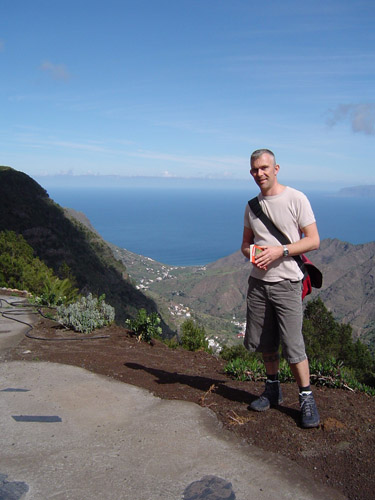
Here is a picture of me and a travel guide, just before it got dark and my brother and I got lost in a forest of mountaineous La Gomera, one of the Canary Islands. So here the tourist is still smiling.
All best to you Eduardo, hope to hear from you soon.
 gomera
Eduardo Graue
Querido Peter aquí estoy viéndote y leyendo tu correo.
Me agrada que podamos platicar y conocernos en este trayecto , pensando sobre estos procesos globales e individuales de migración, joyería, vivir en nuestras ciudades, etc.
Es gracioso imaginar lo que sucede fuera de la foto ¿que es lo que va a pasar? ¿Qué paso? Ese presente.
Muy saludable viajar y recargar energías para continuar trabajando y creando.
Hace mucho tiempo estuve unos días en Ámsterdam, en el centro de la ciudad, fue divertido caminar y vivir ese intrincado espacio. Recuerdo que era engañoso caminar a un lado de los canales sin atención, platicando y no sintiendo la circularidad del camino y quedar sorprendido al rencontrar casas que ya habían pasado, también caminar hacia otra dirección y desorientarse por creer que era la calle por la cual se debería ir.Había mucha gente extranjera viajando en el verano.
Donde vivo, la Ciudad de México, es un lugar muy particular que se reforma constantemente. Algunas veces con la pena de perder maneras muy especiales de resolver problemas de la vida. Asombroso construir una ciudad sobre algunos lagos situados a 2240 metros sobre el nivel del mar. En el verano es aquí cuando la humedad del Océano Atlántico se condensa y cae lloviendo tanto que el lago permanece aun en algún sentido. Si sales afuera de este lugar elevado, durante este período, hacia el campo, te puedes encontrar sembradíos sin agua. dentro de este bello país México, hay muchos tipos de climas, el relieve geográfico y su posición específica dentro de la Tierra son muy peculiares.
Para mi trabajar y hacer joyería, en ocasiones es como viajar hacia otro espacio y tiempo , tan diferente como cambiar de escala y hacer procesos que te regresan a practicas apartadas de la secuencia común de estos días , mucho de la emoción que me provoca, es vivir esta diferente secuencia para la creación de objetos.
Peter que estés muy bien, que gusto ver tu correo , hasta pronto . Saludos
Dear Peter, here I’m, seeing and reading your post
I’m glad that we could talk and by the way know each other, thinking about these global and individual processes of migration, jewelry, living in our cities, etc.
It’s witty to imagine what it happens out the photo, what its going to be? What it was? That present.
Very healthy to travel and recharge energies to continue working and creating
Much time ago I stay a few days in Amsterdam .At the center of the city, it was amuse to walk and live that intricate space. I remember that was deceitful to walk near the channels with out attention, talking, and with out feeling the circularity of the way ,being surprise to find again houses that I all ready past, also, turning to another direction and be confuse because I believe that was the street to will go through.There were a lot of foreign people traveling in summer.
Where I live, Mexico City is a very particular place reformed constantly, some times with the sorrow of loosing very special manners of resolve living problems. Amazing to build a city on the top of some lakes situated at 2240 meters upon the level of the sea. Here is in the summer, when the humidity of the Atlantic Ocean is condense and fall raining sow much ,that the lakes still here in a way. If you go out of this high place, during this period, to the country, you can find there are fields with out water. Inside this beautiful country, Mexico , there are many types of climates, his geographic relief and the specific position on earth are very peculiar.
For me to work and made jewelry in occasions is like to travel to another space and time , sow different as to change the scale and doing process that returns you to apart practices of the common sequence of this days ,much of the emotion that provokes me ,is to live this different sequence for the creation of the object.
Peter, be very well, I´m glad to see your post. Till soon . Greetings
Dear Eduardo
This is a nice surprise to find your first post to me. I just entered the blog because I want to show you a picture of something I just found in the supermarket when I was buying stuff for dinner. I’ll show you at the end of this post.
I smiled, reading you were walking the canals in Amsterdam ending up at the same houses you passed before during your walk, because something similar happened to me when I came to live here in 1983. I remember the first months when I had to go somewhere on my bicycle, I first went to the street I had to be in and then I started looking for the right number of the house. Only after months I learned that I often cycled very long routes this way, because the canals are circular indeed. It is much easier and faster(!) following the smaller streets in between the canals, like the the spokes in a wheel. So yes, very familiar to me in that period this city was very new to me as well.
I happen to have visited your city too, many years ago. It caught my attention to read that you also are living in a place where the people (re)claimed land from the water. Where ever you come: all over the world people seem to know that the Netherlands is for the large part a manmade country and we are living under sea level, on the bottom of what once used to sea. I did not know Mexico City is also built where water, a lake, used to be.
We all have a certain idea about a place before we go there for the first time. And the photo I attach to this post has to do with that in a way. A lot of it is based on what we learned by reading about the particular country, about what you learned at school. On what the travel magazines want to show us. Usually a very bright and ideal image of the country. Some of these prefab ideas may contribute to an even foggier grey when walking that particular area of the world or when leaving the beaten tracks.
It made me smile when I saw this in the supermarket. It immediately made me think of our contact here in the blog. What you see is a foil pack with three packets of cigarettes. Well, cigarettes made of chocolate, meant as a present for children. The fifth of December we celebrate the anniversary of Saint Nicholas (Sinterklaas), the patron saint of children. These weeks children can leave their shoes in front of the fireplace and Sinterklaas puts sweets and small presents in them during the night.
We have been good boys by starting posting to one another, so lets continue and now smoke a cigarette together. Funny to find that package of “Mexico” and that of “Amsterdam” today, next to eachother. Do they really show us our countries?
Best wishes Eduardo, hope to hear from you, Peter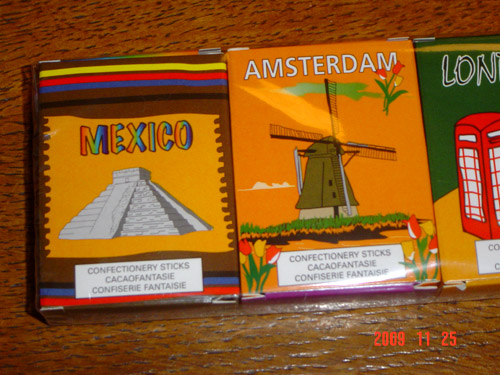
Eduardo Graue
Hola Peter, representativos objetos de lo que sucede en esta época. Desde lo impersonal del supermercado en donde no existe ningún dialogo y solo se presenta el producto sin mas.
Lo paradójico es que la nacionalidad es un concepto muy general que no puede abarcar lo específico de las individualidades que comprende.
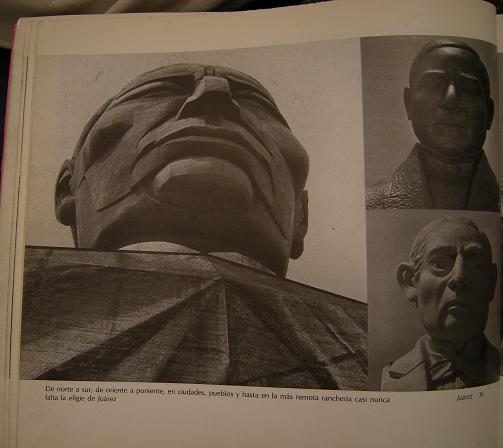
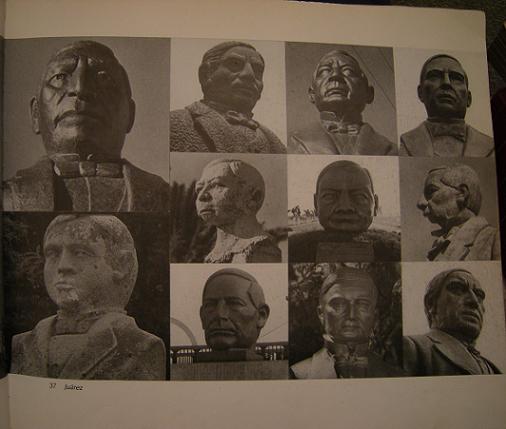
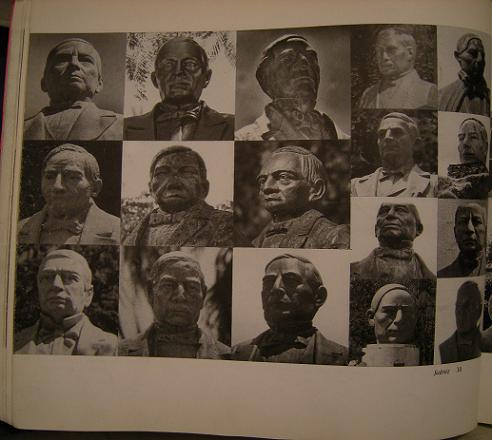
En relación a lo que mencionabas sobre lo que aprehendemos en la escuela, Te envió estas imágenes sobre uno de nuestros muy queridos héroes nacionales, Don Benito Juárez, interpretado de manera muy personal en cada caso para erigirlo como monumento emblemático en diferentes lugares de la Republica.
Peter, nuevamente Calurosos Saludos
Las imágenes provienen del libro” Monumentos Mexicanos de las estatuas de sal y de piedra”Coordinación: Helen Escobedo .Fotografía: Paolo Gori . Ensayos de: Rita Eder, Néstor García Canclini, Fernando Gonzalez Gortazar,Jorge Ibargüengoitia, Jorge Alberto Manrique, Carlós Monsiváis.
Hello Peter. Very representative objects of what it happens in this age. From the impersonal supermarket where is any dialog, and the product is just presented.
The paradoxical is that the nationality is a very general concept that could not embrace the specific of individuality.
In relation of what you said about, what we learn at school, I send you these images of one of our very love national heroes: Don Benito Juarez, interpreted in a very personal way on each case for to erect it as an emblematic monument in different places of the Republic.
Peter again warm greetings
These images belong to the book: “Mexican Monuments: Strange Encounters Coordinatión: Helen Escobedo. Photography : Paolo Gori . Essayfrom: Rita Eder, Néstor García Canclini, Fernando Gonzalez Gortazar, Jorge Ibargüengoitia, Jorge Alberto Manrique, Carlós Monsiváis.
Dear Eduardo,
Here I am again. Thanks for the great photos of the book with all those faces of Benito Juarez. His name sounded somewhat familiar to me, but in a very remote way. I tried to find some information about him and yes: I must have heard and also read his name before. I landed in Mexico-City about nine years ago in the airport that bears his name now. I must have seen his face before on some Mexican bank notes. And I must have read about him in my travel guide in the chapter of the history of your country. I am aware now (again?) that Benito Juarez must have played a major role in Mexico’s progression towards an independent democratic nation. It impressed me to read that a Zapotec orphan sheep herd became the first indigenous president of a nation, in the 19th century! I understand he is much beloved in your country. He slipped out of my memory a bit, I have to admit though. You made me remember him, this vaguely familiar person to me.
We also have our national heroes, but I cannot think of a person who you can find statues of all over the country, the way you can find them in Mexico of Benito Juarez. I have the impression that some of our more famous national heroes have been knocked of their pedestal the last decades. When I was at school I learned about naval officers like Piet Hein and Jan Pieterzoon Coen, our greatest national heroes that brought prosperity and wealth to our nation by trading with countries in the West and the East Indies. Nowadays we are gradually growing aware of the fact that we had nothing to do in those parts of the world. We just took land that didn’t belong to us, colonized the peoples, and even massacred complete islands. Our greatest national heroes turn out to be nothing more than pirates…
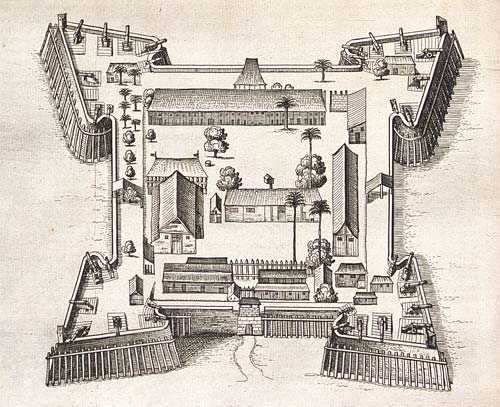 fort nassau - banda neira island When I look at all those pictures of Benito Juarez I see a great similarity in certain facial traits: the implant of the hair and the way it falls over his forehead, they all look very serious with the frowned lines between the eyes, and most of them seem to show determination, will-power. Not a person that has himself fooled around with. Undoubtedly the series as a whole shows the same person, but how different the characters can become when you put two random photos next to each other. Some paired photos might show two entirely different persons. Still, any Mexican citizen might immediately recognize Don Benito Juarez in any of the statues. I have to think of the remark our teacher spatial design made when he was teaching us to model a head in clay. He claimed that one way or the other any artist puts his own familiar personal traits into the sculpture of the model. That’s why all clay heads made by my fellow clasmates and me looked different, still showing the same person.
I will try to find the slides I made when I was traveling in Mexico for three weeks in the year 2000. I will try to find pictures I must have made for some reason. Pictures of to me unfamiliar things, made because of what I saw surpised me, or maybe enchanted me or puzzled me. Pictures that may look very familiar, nothing special to you.
Enjoy this last day of the weekend, that still is younger at your place over there.
Best wishes from a grey and rainy Amsterdam. Take care and till the next post.
Peter
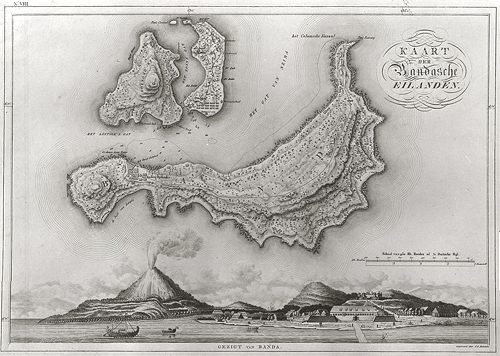 banda islands ($ nutmeg and mace $)
Eduardo Graue
Hola Peter.
Es curioso como en cada región del mundo, a cada población le toca una determinada suerte y se ve en la necesidad de actuar, implementar estrategias para resolver problemas y mejorar su situación. Lo que mencionabas al respecto de Los héroes nada más que piratas. Habrá sido difícil aventurarse a tal suerte y dirigirse a lugares no conocidos con el riesgo de perderlo todo, muy emocionante y vital también el poder abrir nuevas rutas de intercambio y dominio, para regresar con mas posibilidades de bienestar, de conocimiento para el grupo, la familia, etc. Eso ha sido mucho de lo que siempre ha sucedido en este planeta y es difícil imaginar que deje de suceder porque es algo muy esencial al hombre. Lo que si veo, es que parece que hoy existe mayor conciencia sobre las ventajas de realizar intercambios recíprocos y compartir beneficios, Pero siguen existiendo muchas injusticias en algunas partes. Para respetar los derechos de cada ser humano,tal vez tendriamos que ver a toda la humanidad como un grupo, como una familia.
Estuve buscando de qué parte del Mundo eran las imágenes que me enviaste, debo reconocer que no tenía muy presente cuales eran las Colonias de los Países Bajos en el Oriente. Más bien si recordaba aquellas distribuidas en el Océano Atlántico, en las Antillas, en Sudamérica en Norteamérica.
Comienzo a comprender, que lugar tan especial y estratégico, lleno de recovecos por tantas islas volcánicas y situado casi todo en línea con el ecuador, muy diferente de los Países Bajos. Es impresionante como en un tiempo tan breve todo el planeta quedo conectado, Aquí como parte de las expansiones españolas, la Nueva España fue el punto desde donde se pudieron establecer intercambios constantes con esa parte de Oriente un poco más al norte, otro archipiélago que se convirtió también en colonia española.
Acabo de entrar a tu página y es muy agradable contemplar todos los objetos. Como el tema, la imagen fotográfica de cada serie, contiene una idea principal muy esencial que los engloba y lleva a meditar en diferentes direcciones desde los objetos. Son muchos trabajos y en todos, los elementos formales, los materiales, las articulaciones, están muy bien conjugados. También son muy útiles las medidas para imaginar los tamaños de los objetos. Me gusta como incluyes objetos que pertenecen a otra clase ,diferente a la de joyería, y luego como su función se vuelve más simbólica por el ligero cambio del tamaño para formar el objeto de joyería , relacionado con la idea principal de la serie.
Tengo mas observaciones y preguntas al respecto que te enviare en el futuro
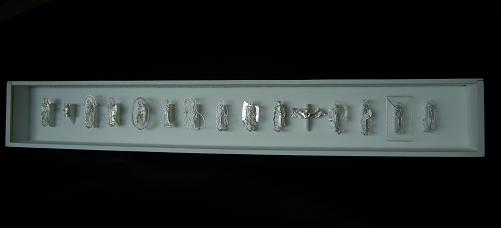
Peter nos vemos pronto , te mando la imágen de este trabajo que realice en diciembre de 2006 para una exposición conmemorativa sobre la Virgen de Guadalupe
- Título :” Ofrenda de un Segundo para la Virgen “
- Medidas-100 cm. x 13 cm. x 7 cm. Caja
- Materiales. Objetos de plata 925. Caja mdf y vidrio
Buena suerte y que estés bien
Hello Peter
Is curious how each region of the world, each population got a specific luck and gets into the necessity to act, implement a strategy to resolve problems and improve his situation. What you said about, heroes nothing more than pirates , it had to be very difficult take the adventure going so far to unknown lands with the risk of loosing everything, very exciting and vital also to open new ways of exchange and power, to return with more possibilities of advantage, more knowledge, for the group, the family, etc. This had been much of what it always happen in this planet and is difficult to imagine that stops because is something very essential to human being. What I see now, is that it seems to be more consciousness of the advantages of reciprocate exchange and share benefits , but still being a lot of injustices in some places. to respect the rights of every human being, maybe we have to see the whole humanity as a group, as a family.
I was trying to get from which part of the world were the images you send me
I have to recognize that was no to much present to me where were the Netherlands Colonies in Orient. Much better, I remained that ones into the Atlantic Ocean in: The West Indies, North America, South America.
I began to understand, what a estrategy and special place ,so full of ins and outs because of the volcanic islands ,aligned with the equator, so different to Netherlands. Is amazing how in a sow short time, the entire planet was connected. Here, as part of the Spanish expansions, the New Spain was the point from where has established a constant exchange with that part of Orient , an other archipelago a bit more at the North of the Netherlands Indies
I enter into your page and am very pleasant to look all the objects. How the theme, the photographic images of each series has a principal idea that lumped together and takes you to meditate in different directions from the object. They are many works and in all cases, the formal elements, the materials, the articulations are very well conjugate. Also is very useful to see the size of the objects and imagine them. I like how you include objects that belongs to a different kind of jewelry ones , and how their function became more symbolic because of the slight change of size to form the jewelry objects, related with the principal idea of the series.
I have more observations and questions about it, that I will send you in the future.
See you soon Peter, I send you this image of a work I have done in December of 2006 for a commemorative exhibition of the Guadalupe Virgin.
- Title:“Offering of one second for the Virgin “
- Size box:100 cm x 13 cm x 7 cm
- Materials: Objects of Silver 925. Box mdf and glass
Good luck and be fine
Hi Eduardo,
We are travelling into the grey past here talking about the histories of our countries. Uncertain about what the future will bring, the past has its mysteries as well. Educated here in mainly the Dutch part in the era of colonisation and decolonisation, and less about the Spanish annexations and losses on the worldly stage in those days, I am surprised to hear about -New Spain-. I didn’t know Mexico was called that during Spanish colonization and it even more surprised me that an archipelago as distant as the Philippines belonged to that very same viceroyalty as Mexico. When you look at it that way, Mexico and the Netherlands have been neighbouring countries over 300 years! Mexico as a part of New Spain and the Netherlands with its extensions in the Dutch Indies. Strange huh, to realize that nowadays? And you are right: how very, very different that tropical archipelago is from our misty swampy low countries here. How very different the lifes of the inhabitants.
The work on the photo you sent me intrigues me and attracts me. Like you (probably??) I was brought up with the catholic religion. In my case in quite a severe way: the weekly obligatory church visits, lots of sins to ask forgiveness for and nevertheless never ending heaps of mea maxima culpa! And that devil always lurking around some corner. Even my high school was led by Franciscan monks, some of them still in their brown robes and a piece of cord around the waist. As an adolescent I grew more and more rebellious against the official church with all its prejudices and dogmas. Finally I had myself unregistered as a catholic.
Statistically a non believer now I still do visit places of worship. I am that kind of person that visits churches when abroad. Temples, mosques, synagogues, wherever I am allowed I enter and participate. Not only for the cultural aspects, but also for the positive energy and mystic of those places. For the good intentions of the visitors that have been coming to these places for centuries often. They often are very inspiring places in special and beautiful locations. I still light a candle in church and there is that part from my catholic past that will never go away I suppose. (Guilt not the least of them…)
When in Mexico I visited quite some churches. I saw quite some images of the Lady of Guadeloupe. And it is only now that I learn that “Guadeloupe” is not some town far away from Mexico City. If I had known that it actually is very near to the city I certainly would have gone there. I will keep that in mind for a future visit to your country.
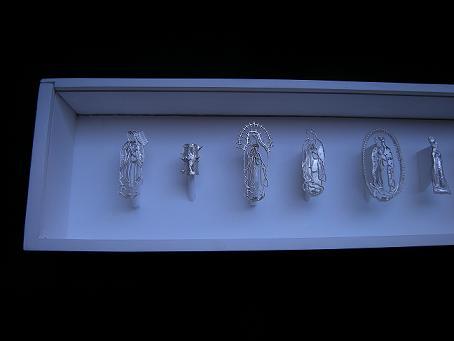
I wish I could have a closer look to your work on the photo. Do you have a close up? Can you tell a bit more about it? It now tells me a story about the growing distance between hasty people and their religion. The medals are in a box on display and cannot be touched and used anymore. It is a long box and you walk passing by the small images of the Virgin. The title tells me this only takes a second. You may have meant something different, I don’t know. Anyway I like to see it and it makes me think and wonder. Tell more about it please.
I haven’t had a look at the slides I made in Mexico yet. I am trying to find my slide projector. I must have that pre-historic device somewhere. I hardly ever use it anymore in this digital era. During my travel through Mexico I used my analogue camera for the last time before switching to digital.
Talking places of worship and talking seconds: I will this time include a link to a movie of an Indian temple. It is in the South of India in Tirumala. It is the only place in India where non-hindus are allowed into the inner sanctum of the temple grounds. It took us hours and hours waiting in line before we reached that golden roofed inner temple, even in that faster queue you had to pay extra for. I don’t know if it was the heath, or the chanting of the devotees around us that contributed: reaching the statue of Lord Venkateswara fulfilled me with awe, some kind of ecstasy. Among endless numbers of people we were all allowed to see the statue for only a few seconds, then we were blessed and directed and pushed onwards to the exit by the priests. I remember us being allowed to watch a few seconds longer which was real nice of them. Maybe because we looked different or had come from far away. I also remember some disenchantment stepping into the noise of rows of rattling teller machines immediately after leaving the sanctum. Without stopping counting the coins donated by the pilgrims.
Here is the link: http://www.youtube.com/watch?v=Ze_e0ZMsgLM
It is an old movie, but when it would be in colour, it would just be like when I saw it. Time seems to have been standing still in those old temples still in use.
This I found on the internet:
The temple is the richest and the most visited place of worship in the world.[1] [2] The temple is visited by about 50,000 to 100,000 pilgrims daily, while on special occasions and festivals, like the annual Brahmotsavam, the number of pilgrims shoots up to 500,000, making it the most visited holy place in the world.[3]
from http://en.wikipedia.org/wiki/Tirumala_Venkateswara_Temple
It sure was crowded and did hear lots and lots of coins! But many hot hours and a few blessed seconds never to forget. Let me wish you a wonderful Christmas on this Christmas eve. Will you attend mass? All best to you and till soon again.
Peter
Eduardo Graue
Hola Peter.
Disculpa por no enviarte antes detalles claros sobre esta pieza.
Esta idea surgió como consecuencia de una exposición conmemorativa sobre la Virgen de Guadalupe celebrada en Diciembre hace 4 años, en el 2006
A mi me atrajo la idea de establecer un juego con la misma relación que existe, entre un segundo de película de cine y sus imágenes estáticas para formarlo.El poder extender un segundo y revisar lo que sucede dentro de este, des configurar en subpartes que pasando veloces, le dan forma a esta imagen. Partes estáticas que pueden no ser semejantes a la que conocemos como la imagen de la Virgen de Guadalupe.
La Virgen de Guadalupe es la imagen religiosa con el mayor número de feligreses en México, existen otras representaciones de La Virgen Marial relacionadas a su lugar y modo de aparición, prodigios etc. : la Virgen de la bala, la Virgen de los Remedios, la Virgen de San Juan de los lagos, la Virgen de Zapopan etc. También existen representaciones de Cristo como: El Cristo del veneno, El Cristo de Chalma, etc. En todos los casos estas imágenes están enlazadas a la narración de algún acontecimiento excepcional milagroso que relata su origen y al que se le van sumando prodigios y milagros a lo largo del tiempo para con sus feligreses, esta participación por la devoción en la imagen y lo que simboliza, es una puerta muy rica hacia la individualidad de las experiencias y una interpretación muy personal de la realidad en cada caso.
Tanto los españoles como los diferentes pueblos prehispánicos siempre tuvieron gran devoción por sus dioses y en este encuentro violento le fueron dando forma a estas imágenes. Gran parte de los santuarios religiosos están localizados sobre antiguas poblaciones prehispánicas y en específico sobre lo que fueron sus centros ceremoniales. Se establecieron en este lugar los santuarios para evitar la orfandad como consecuencia de las cruzadas evangelizadoras, unifico a pesar de muchas diferencias que aun persisten, a casi toda la población en un solo culto católico
No todas estas imágenes han gozado de la misma adoración y su abandono en algunos casos se debe, a que la población devota se desplazó a otra parte como en el caso de la transición de la Nueva España al México independiente. Gran parte de la atracción que poseen aquellas muy fuertemente queridas como la Virgen de Guadalupe se debe a la particularidad de ese relato milagroso que hace participe a un número grande de población.
Los iconos religiosos son imágenes que tocan el extremo de lo imposible posible, que uno vive a través de su relato, en el que se evoca la esencia de lo divino, presencia de un tiempo eterno detenido en esta realidad , protegen, estabilizan, pero también limitan, evitando la sorpresa ante lo imposible posible más inmediato del presente.
Creo que lo que percibimos en el mundo, tiene que ver mucho con la relación que se establece entre los acontecimientos y el tiempo. Uno es lento para entender los acontecimientos. En muchos casos se sobre entiende la realidad en la que uno fluye. Existen momentos especiales en los que, lo que se supone, no es lo que sucede y, esto, sorprende, espanta, puede obsesionar, o ampliar nuestra atención, destrabando la mecánica de nuestras suposiciones. Extender los límites del mundo que nos rodea. Ser más objetivo ante las diferencias del mundo.
En el inicio los objetos dentro de la caja se dispusieron para formar toda la serie cerrada, pero con el tiempo he pensado que su uso como broches, extendería dentro de la práctica, las posibilidades del objeto en su conjunto,
Yo no me considero cristiano católico aunque parte de mi formación siempre tuvo una influencia en ese sentido. Por parte de mi abuela materna conocí en algunos períodos de mi infancia asistir a la misa. También me a tocado estar ,en alguna boda o acontecimiento excepcional. Ella si era católica y nos invitaba de pequeños a participar de estas experiencias. Eran momentos especiales en los que jugaba con mis primos también reflexionar en el evangelio algunas veces doloroso siendo niño sentir el vivir tan extremamente.
Los templos y santuarios siempre son imponentes y como bien dices, su localización casi siempre es extraordinaria, cerca de manantiales, con vistas excepcionales, como si parte del reino de lo eterno aterrizara aquí en la tierra. Es muy atrayente conocer la historia de estos lugares y entender la dinámica de su función y formas. Tal vez es necesario construir sobre una estructura sólida de reglas ideales. Si yo dijera que no creo que dios existe me sorprendería mas al verme aquí, viajando en este planeta hacia algún punto del universo junto todo nosotros y los demás seres vivos en condiciones tan sutiles como tan solo unos pocos kilómetros de biosfera junto a miles de millones de kilómetros sin vida y con nuestros 36.5 º C de temperatura corporal arriba en un coche o en un avión a 800 Km /h, Pero también sentimos por medio del cuerpo tenues vibraciones como lo que vemos en la luz. Y probablemente más de lo que podemos suponer.
Peter, tratare de ser más conciso y rápido en los siguientes correos, Gracias por los buenos deseos de navidad y año nuevo. Yo también te deseo lo mismo y que todo sea grandioso en el futuro.
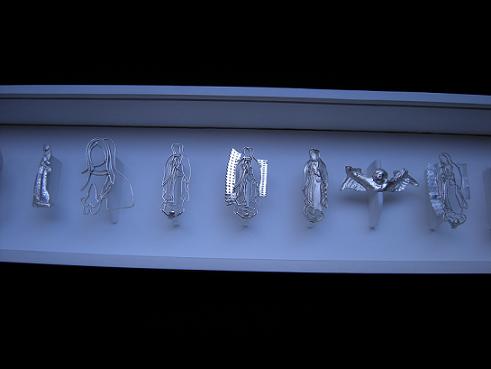
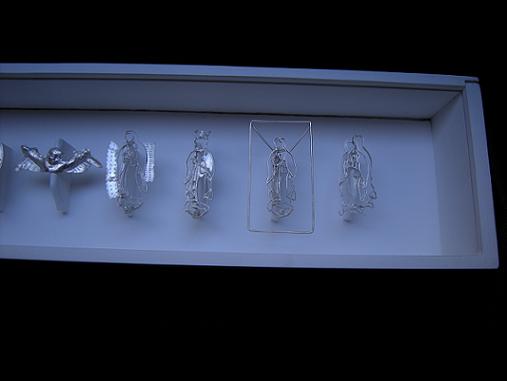
Hello Peter
I’m sorry for not send you before clear details of this work.
This idea come as a consequence of a memorial exhibition for the Guadalupe Virgin celebrated in December, four years ago, in 2006
My attraction was to establish a game with the same relation that exist between one second of a movie picture and their static images that give form to it. To extend a second and revise what it happens inside. On configure sub parts that go fast giving shape to this image. Static parts that could not by similar to what we know as the image of the Guadalupe Virgin
The Guadalupe Virgin is the religious image with more number of worshippers in Mexico, their exist other representation of Mary related to their place and way of appearing, prodigies etc : La Virgen de los Remedios, La Virgen de la Bala , Virgen de San Juan de los Lagos, La Virgen de Zapopan , etc. Also are representations of Christ: El Cristo del Veneno, El Cristo de Chalma, etc. In all cases, this images are connected to the narration of an exceptional miraculous happening that relate his origin and to whom his prayers add miracles and prodigies along the time, this participation for the image devotion and what it means, is a very rich door to the individuality of the experiences and a very personal interpretation of the reality in each case.
Many of the religious sanctuaries are located upon the ancient prehispanic populations and specifically on where it was their ceremonial center. They established the sanctuary in this place to solve the orphanage as a consequence of the evangelist crusade , this unify ,even a lot of differences that still persist , almost al the population in one catholic cult .
Not all this images enjoy the same worship and his abandon is because its prayer population goes to another part, like in the period of transition of the New Spain to the independent Mexico, when the Spanish population born in Spain goes.
The attraction of the very well loved images as Guadalupe Virgin, is because the particularity of that miraculous narration that gives enter to a big number of population
The religious icons are images that touch the extreme of the impossible possible that is inside the narration in which is evocate the divine essence, presence of an eternal time in this reality, they protect, stabilize, but also put limits to avoid the surprise and the impossible possible more close of the present.
I think that what we perceive in the world has to by very much with the relation that is established between the happenings and the time. We are slow to understand the happenings, in many cases the reality were we flow is super understand. There are special moments in which what we suppose is not what it happens , and this cause surprise , frighten , could become an obsession ,or unfetter our attention of the mechanic of our suppositions. Extend the limits of the world that surround us, being more objective to the differences of the world.
In the beginning the objects in the box were disposed to form a closed series, but by the time I think that they can be use as brooches, extending in the practice the possibilities of the whole object.
I don’t consider my self as a Christian catholic, even though parts of my formation always have an influence in this way. From the part of my grandmother mothers, I know what it was to be in the mass during my childhood, also in other time during wedding or other occasions .My grand mother really was catholic and invites us to participate of these experiences. There were special moments to play with my cousins, also to reflect about the gospel, sometimes painful being child, feel to live so extremely
The ancient temples and sanctuaries are always imposing and as you well said their locations are always extraordinary ,near spring of water , exceptional views, as if part of the of the eternity reign ,land here on the earth. Very attractive know about the history of this places and understand the dynamic of his function and forms. Maybe is necessary to built upon a solid structure of ideal rules,
If I said that I don’t believe that god exist, I will be more surprise to see me here traveling in this planet to some point of the universe altogether with other kind of life and within so subtle conditions as being just in a few kilometers of biosphere next to thousands of millions with out life and with our 36.5 ºC degrees of corporal temperature up in a car or an airplane at 800 km/h, But also we feel because of the body tenuous vibrations like what we see on light and probably more than what we suppose.
Peter, I will tray be more concise and fast on the next posts, thank you for the good wishes of Christmas and New Year. I also wish you the same and that every thing will be great in the future.
Hello Eduardo,
Thank you very much for taking and posting the close up pictures of your -Offering of one second for the Virgin-. What I thought to be religious medals are the outlines of the static images of the virgin taken from one second of film. I like it to have a closer look and also to read your thoughts behind it, because yes, we all form our own ideas around the images that reach our brain through the light waves that fall upon the lenses of our eyes. It is a miracle in itself when we all perceive those images as more or less the same concept, like in this case of the Virgin of Guadeloupe. Who, you tell, must have had a major contribution to the unification of what is now called Mexico: the Virgin is considered to be the mother of all Mexicans. The practice of having each part of this installation going its own way in the end in the form of an individual brooch beautifully corresponds with what you tell about the way each of us fills out what happens to us in daily life in a very personal way.
We humans can have the tendency to try to place phenomena that happen around us and which we find hard to understand into the realm of the supernatural. In a more or lesser extend we all do that. It is especially the case where large amounts of people find one another in the mutual adoration and belief in a divine being. I wonder why the story of the Virgin of Guadeloupe in particular turned out to have such a great recognition by the majority of the Mexican population.
Very clever those Spaniards to impose their religion upon other peoples by incorporating the ‘pagan’ sanctuaries and worship into the official faith. The church of Rome has also done this in christianizing this part of the world. I think all major world religions have done this in order to extend their influence. That explains the many regional differences in the practice of Catholicism, Hinduism, Buddhism. And they all may need these exceptional places of eternal beauty on this earth to have their centres.
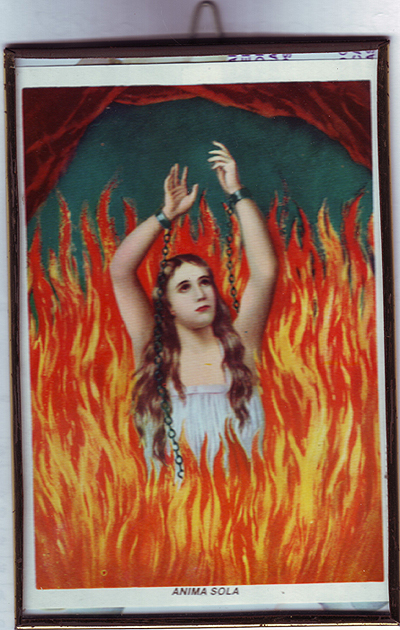
When I was in Mexico I bought a small image that I have in my studio. I see it daily. I bought it because in some way it echoed the idea of a purgatory I grew up with and also because it tells about liberation. Nevertheless I had never seen a picture like this. The woman in the picture doesn’t seem to be hurt or tortured by the flames. I find it a strong image. Now the picture is on the wall near the kiln I fire my work in: the little purgatory where my objects turn from something out of loose powdery river clay into firm and lasting ceramics. Which is also a miracle in itself.
As you may have seen I love to work with ceramics, I just find the material beautiful. I started experimenting with it in 1994, and as a matter of fact I still am. I was not educated in ceramic design which may have its disadvantages in technical know-how, it also gives me a quite open approach of using it in jewellery. I like the plastic property of the material next to the often rigid materials like metals and stones we usually work with in the field of jewellery. With each collection I try to find new solutions in making vulnerable and breakable ceramics wearable. And in each new collection I am introducing new techniques. This way I keep learning about the material and this way working on my jewellery doesn’t become boring. Because I am trying out new ways of using ceramics in jewellery, during the experimental stages it is a surprise often what the work will look like when I open the kiln door. Did that glaze turn out okay? Was it the right temperature? Are these types of clay compatible? Etc, etc. Sometimes days and days of work may be completely destroyed in just a few hours of firing. So yes, I need a small saint next to my kiln! 
Also in my work for WGA I would like to use clay.

During the years I have been working as a jeweller I often heard the remark that my work looks like ethnographic jewellery. But when you ask people where they think it originates from then, they find that question very hard to answer. Which makes sense to me, because I can’t tell them either. It is something that is in fact not ethnical, because it has been made in the here and now. In that sense it is fully contemporary jewellery. That is looks ethnic undoubtedly has to do with the fact I am interested in the utensils of other peoples and often find amazement in the function they have and beauty in the way they were made. I use my own form elements however to achieve a similar eloquence. Repetition a major one of them. Natural materials and techniques used by peoples over thousands of years also one. And ceramics sure is!
I am thinking about making a necklace that looks like it may have been made by a Mexican (jeweller). Will Mexican people seeing it embrace it at something of their own of won’t they? This could be the same issue people have to deal with when they move somewhere else and try to adapt to their new environment, no matter how hard they try. Will they become part of the new land/identity or will they in some way always stay foreign? I tend to think the latter, because of not shared history together. In this way our dialogue is a great contribution to the work I am to make. You make me aware of a new history that is not mine. Thank you for that.
I am also curious what direction your plans for a piece of jewellery will go in our dialogue. Hope to hear from you soon. In the meantime be well. Peter
Hi Eduardo,
How are you doing? Are you getting along with your work for WGA?
Last week I did find my slide projector and I scanned some of the slides, because I also wanted to show them with a lecture Valeria, Andrea, Jorge and I gave about the WGA project last Sunday. Jorge and I were showing both our work and also talked about our participation in this project.
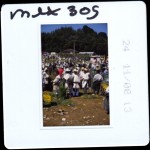
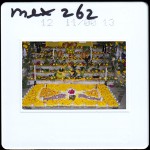
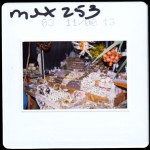
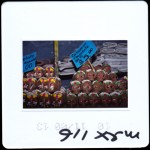
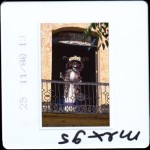
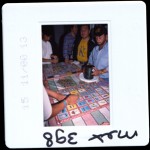
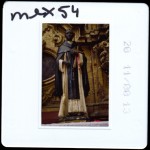
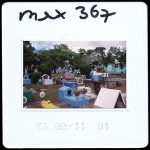
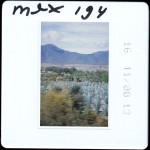
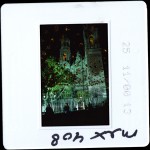
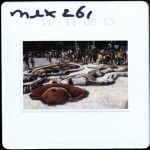
I told you my first encounter with Mexico was ten years ago. I had made sure to be there during the Dia de los Muertos festivities. My slides therefore not only show many churches, saints and landscapes, but also stacks of skeletons, skulls, bones, graveyards and marigolds. Here are some:
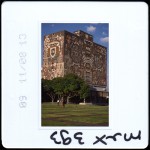
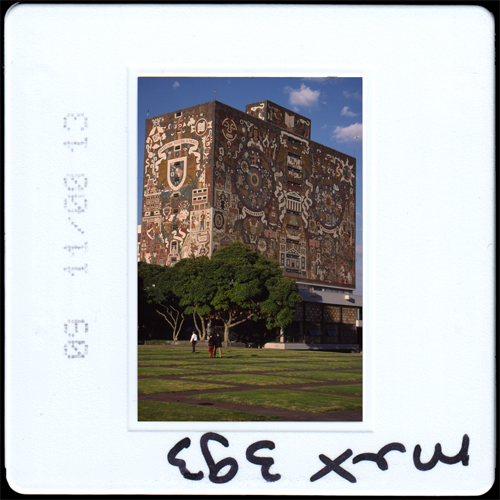
Images familiar to you no doubt, but very new and impressive to me they were. I started the lecture with a slide of the Central Library building at the UNAM campus in your city. The building was in a book I had as a kid with the one hundred world wonders in it. So I absolutely had to see that wonder, which became Unesco World Heritage two years ago. I liked it and still like it very much. It looked so beautiful and the concept is also great. The building houses one of the largest collections in Mexico, over 400,000 books, and the murals that cover the library are made of tiles that come from all over the country, for the many colours needed.
We talked several times about the histories of both our countries, in the case of Mexico also a history that happened to be depicted in the murals of the Central Library. At the beginning of the blog you told you have a background as a painter. To my surprise you contributed to the mural paintings in the Copilco Metro station. This station I used together with many students when I was on my way to the Central Library building ten years ago. The station must have been work grounds for you for a certain period of time.
I agree with you that the achievements of modern science and technology enable miracles in themselves. To me it still can feel magical that I have been able to visit a place I wanted to see at the other side of the world. I’ve been brought there in a flying tube out of metal that’s climate and pressure controlled. An underground system rushed me to the building I wanted to see, that has modern achievements on one of it four walls.
Through you I meet with Mexico for a second time. This time it is not the religious and folkloristic Mexico I wanted to visit ten years ago, but the Mexico of an artist living in one of the largest cities in the world. We contact eachother through another wonder of technology: the internet. Something that wouldn’t be possible ten years ago. Here you tell me about your ideas, show me books and your work. I want to do something with the contrast between my first Mexican encounter and the second one with you. On the one hand the folkoristic, religious, historical Mexico and on the other the scientific, urban, educated Mexico. I want to capture them in one piece of jewellery. They are to be one.
Eduardo, all best and hope to hear from you. Peter
Eduardo Graue
Debió de haber sido agradable el evento en el Stedelijk Museo en Schiedam el domingo Peter.
Es muy atractiva la imagen que enviaste, es placentero imaginar ese eco en relación con el horno, la cerámica como un material que primero es modelado, más plástico y la transformación durante el saborear el tiempo , esperanzado hasta que abres la puerta y vez. Los bien hechos objetos, o cargar con la cruel realidad de no pasar a través del fuego y empezar una nueva vuelta.
Lo que también veo en esta clase de procesos son las grandes posibilidades hacia el futuro. Hay lugares que no están del todo definidos debido al juego de diferentes materias involucradas en ellos. Esto da muchas nuevas experiencias moviéndose a través de la experimentación, mucho placer de controlar nuevas cosas.
También hay una valoración moviéndose hacia el futuro y creo que más indefinida, Hoy todo dura tan poco tiempo porque se desgasta inmediatamente, hoy todas las cosas pueden ser lo mismo y eso es doloroso porque en este caso implica un gran esfuerzo para encontrar algo y darle un sentido personal a lo que es creado.
En estos últimos años el material que más frecuentemente he utilizado en mis trabajos es la plata. Aquí te envió imágenes de otros trabajos mas recientes con otro sentido. Me gustan porque implican el alcanzar nuevos resultados, llegar mas lejos en la versatilidad del material también extender las posibilidades expresivas. En el principio fue muy lento el aterrizarla manera de concretar la construcción del proceso, pero aparecieron caminos inesperados para llegar a la solución.
Me gusta mucho cuando se trata de encontrar una solución para algo tal vez no es posible y en cada paso que se da la mente esta obsesionada con ello
También cuando encuentras la solución es como tener la magia que hace posible incluir objetos que no era compatibles antes, entonces tu extiendes las posibilidades para incluirlos , y también tomas más atención por ellos.
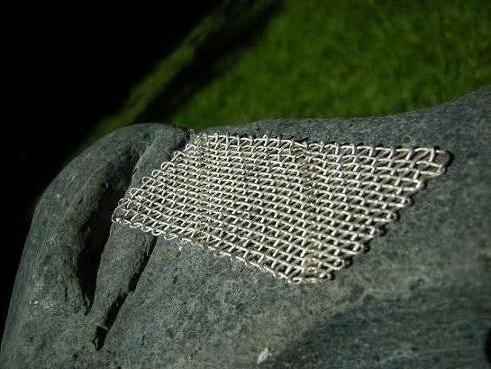
Ambos están realizados cocn red de metal (Plata 925) , estructura que es fácil de doblar
Los nombres de las piezas son:
- Brazalete “Curación de ademán”, plata 925 ,10 cm.10 cm. x 10 cm. .
- Collar o corona ,”tetraedros”, Plata 925 ,50 cm. x 4 cm x 4 cm
Hasta ahora no estoy seguro aun como será la idea principal de mi trabajo, por el momento he seguido entrando a tu página, preguntándome y reflexionando algunas ideas que te enviare pronto.
También aquí te envió unas imágenes de cómo se veía el Zócalo de la Ciudad de México en las vacaciones de Navidad y Año Nuevo.
Saludo, escribo pronto.
Must be nice the Sunday event at the Stedelijk Museum in Schiedam Peter.
Is very attractive that image you send, pleasant to imagine that eco in relation with the kiln, the ceramic as a material that is first modeling, more plastic, and the transformation during the taste of the time hopping until you open the door and see. The well made objects, or carries the cruel reality of no past through the fire and start again the new round.
What I also see in this kind of processes are the big possibilities toward the future. There are places that are not yet defined because of the game of different subjects involved on them. This gives a lot new experiences going through the experimentation, a lot of pleasure to control new things.
Besides there is an appreciation going through the future, I think more indefinite. Today every thing survive so little time because is wear away immediately. Today everything can be the same and that is painful because in this cases imply a big effort to find something and give a personal sense to what is created.
In the last years the must frequent material used in my works is silver, here I send you images of another more recent works with a different sense. I enjoy them because they imply to search, new results, get farther in the versatility of the material, also to extend the expressive possibilities. In the beginning was very slow to land the way of how to concrete the construction process, but unexpected path appear to get the solution.
I like a lot when you try to find a solution of something that maybe is not possible and on every step is given, the mind is obsess with it, also when you find the solution is like to have the magic that make posible to include objetct that where no compatible before ,then you extend the posibilities to include them and beside you take more attention to them
The names of this objects are:
Both are done as metallic network of metal (925 silver) structure easy to turned.
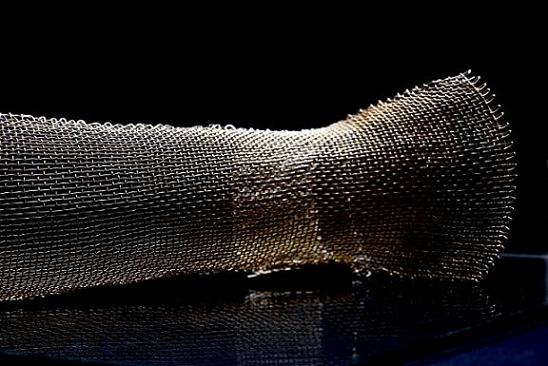
- Bracelet “Manner cure”, 925 silver, 30 cm x 10 cm x 10 cm
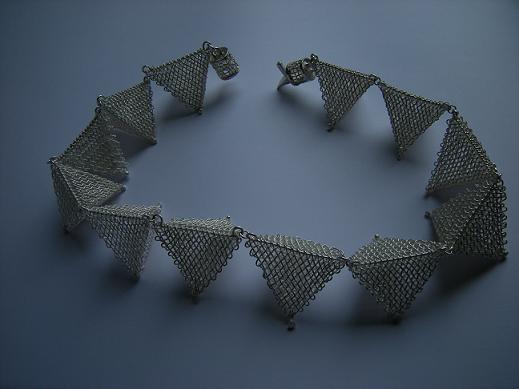
Necklace or crown, “tetraedros”, 925 silver, 50 cm x 4 cm x 4 cm
Until now I’m not sure how it will be the principal idea of my work. For the moment I continue opening your page reflecting and asking me some ideas, That I’ll send you soon.
Also I send you image of how it was the look of the Zócalo of Mexico City in this Christmas and New Year vacations.
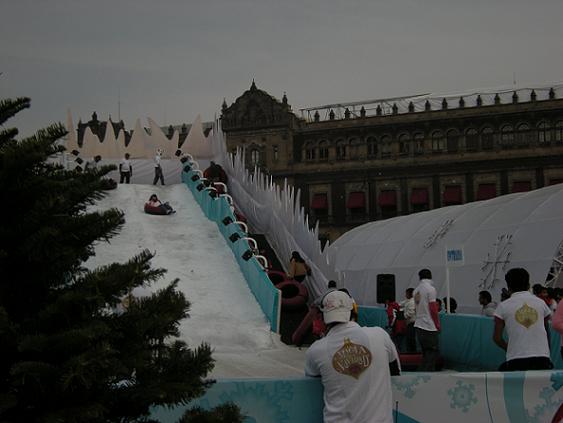
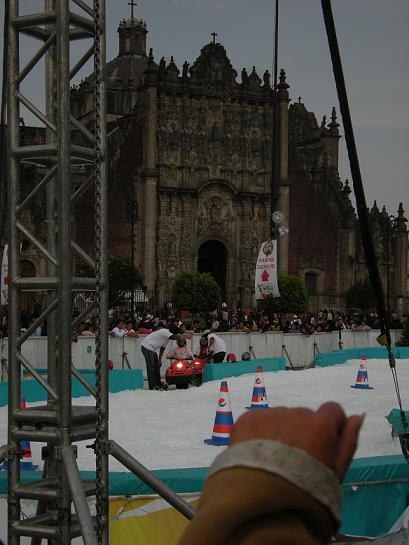
Greetings, write soon.
Hi Eduardo,
Thanks for sending me the Zócalo. It looks very different from the few times I walked there, under blue skies and the central square almost empty. And I am glad you had some snow with Christmas as well! It looks like the perfect combination: snow and no need to wear thick heavy clothes. That richly sculpted entrance of the Cathedral looked somewhat familiar, but thanks for telling me it is the Zócalo: otherwise I wouldn’t have known. It makes me aware of the fact that just like my tourist photos are only snapshots in time, also these photos are. Here is a photo I took from the plane just before landing in Mexico City International Airport, filled with anticipation. Look at all those patches of bright vivid colour in a field of blurry grey.
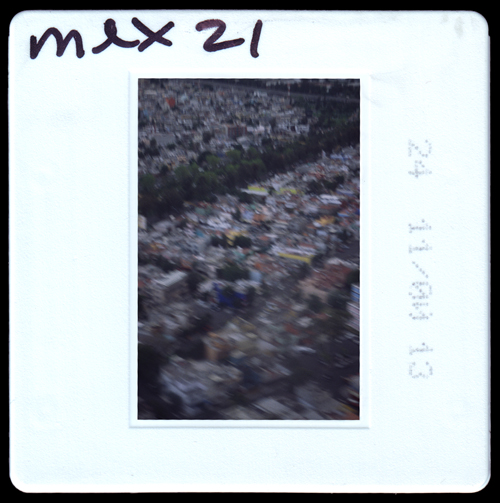
You step out of that plane and while your mind is still halfway the place you just came from, your body walks strange and new soil. I also can experience it when coming back in my home town, especially after been away for some months or even a few weeks: the city looks very familiar, but at the same time new again. All of a sudden you wonder if that shop on that corner has always been there or if it changed owner in your absence. The streets and the people look different. Jumps in time. Your mind still has to catch up with your body.
Incredible how far we go in trying to change our natural surroundings and change it the way we want it to be. Here when winter is getting near, the restaurants and cafés warm their terraces with these gas fuelled ‘parasols’ that radiate warmth over the people sitting under them. At those chilly temperatures you used to find yourself a table inside. A friend of ours in Barcelona keeps his terrace cool in the burning sun of summer by using machines that not only fan but also keep spraying a fine mist of water over the customers. Wonderful we can enjoy that all now, but sometimes it also looks like an incredible waste of energy to me. But sure yeah: I also make use of these innovations often enough. Now I can enjoy sugar peas and tomatoes whenever I want, swim in mid winter and learn to ice skate from October to March! And fly wherever I want to!
I like the way you make silver look like pliable fabric. Especially the bracelet looks like finely woven pliable textile, beautiful, and also a handsome photo by the way. The necklace seems to be made with thicker ‘threads’ and looks more rigid, also because of the smaller triangular areas. Funny you can also wear it as a crown. You don’t use fabric in your jewellery, but interestingly, you use a textile technique to treat the silver with. In the weaving you can make it look like textile, but using another material than a woollen or cotton thread, you’re able to mould and shape at the same time. Widening the structure, narrowing it, by adding or lessening ‘strands’. Or gradually changing the mesh. Your textile works won’t loose their form when dropped. I can imagine this will lead to many more things to discover: you are using the best of two worlds, sort of speak. You can build complete 3D organic structures like this. To me, these areas where two (or more) fields in design/art/craft overlap are the most promising and interesting. These are the areas where real exploration can be done, experiments with surprising outcomes. Yes, I know exactly what you mean: the unexpected paths that appear! That obsession, that struggle and then the magical blissful moments of solution, that make it all fit together. And consequently all those doors to new territory that open. That’s what we are doing this for, right?
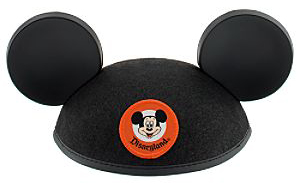
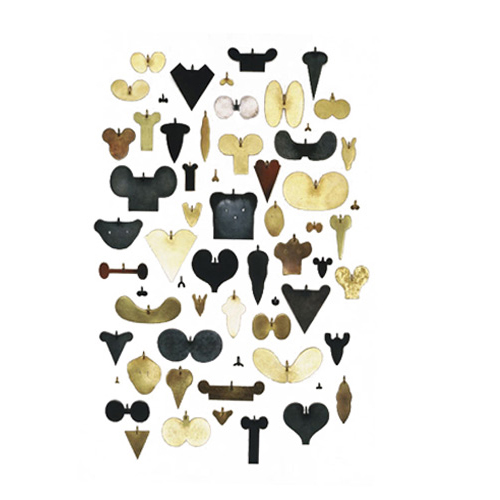
I intend to make a ceremonial necklace that may have been dug up somewhere in Mexico at first impression, or made by a present Mexican potter/jeweller. Now I all of a sudden have to think of that powerful project Otto Künzli (Switzerland) did a long time ago (early 90’s?) in which he commented –if I am correct- on the United States culture that seemed to lack real history. Part of that project, he made all kinds of pendants that were a series of artefacts (with pre-Hispanic names) from different periods in time and different excavations in the American continent and therefore different in style: forerunners of the present Micky Mouse symbol. What a masterly and smashing project I still find that. Like many of his ideas. I found a small image of it on the internet:
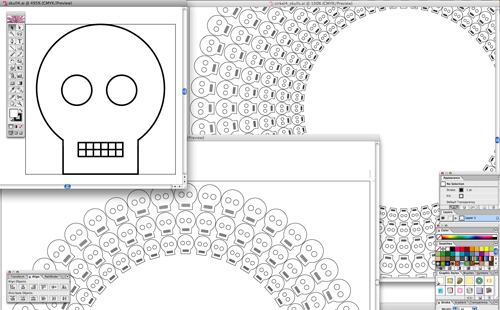
But to continue with necklace to be: I used my computer in making the first sketches of a necklace out of Mexican symbol numero uno: skulls-skulls-skulls. Well to the world outside Mexico that is. The strange thing is, that when you see heaps of real skulls the association with Mexico is not there. Then they are considered nation-less, something universal. But applied in arts and crafts as a motif all of a sudden the skulls seem to be Mexican. So no: of course my skulls won’t be Mexican (alone the fact I made them here), but as a motif they will look like they are. Here is a screenshot of my Illustrator files.
Enjoy the weekend Eduardo. Will stop now, but we’ll talk soon again. Looking forward.
Back again,
We had some snow again last night, so I woke up in a black and white world. Because of our moderate maritime climate we don’t have snow that often. This is the view from our windows at the back. No forest here, but the centre of town. This is what the gardens look like enclosed by the blocks of houses.
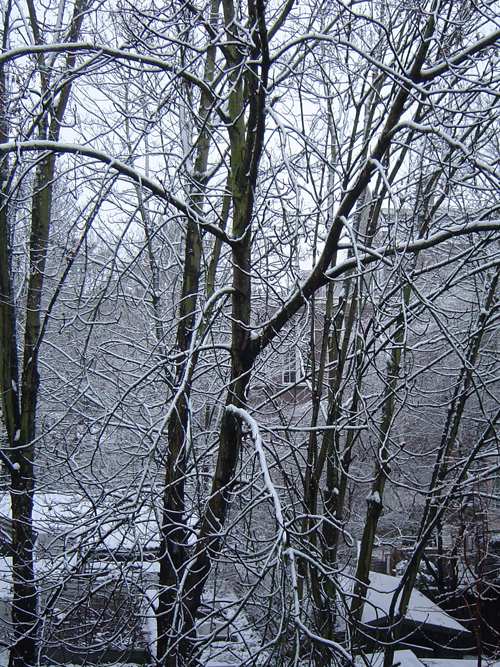
Regarding my posting of yesterday and the photos of your work in mind:
Wherever I come I am immensely attracted to ceramics and basketry. Like a magnet I am drawn towards places that show or sell these products. (Almost?) any country seems to have a history in ceramics and in basketry, using their own clays and using their own fibres (palm leaf nerves, willow twigs, bamboo strips, reet stems). And the famous Dutch delftware is in fact a local imitation of Chinese porcelain. Because the Europeans didn’t know the techniques to make porcelain and because porcelain clay isn’t found in Holland they started to make earthenware look-alikes in blue and white in the 17th century.
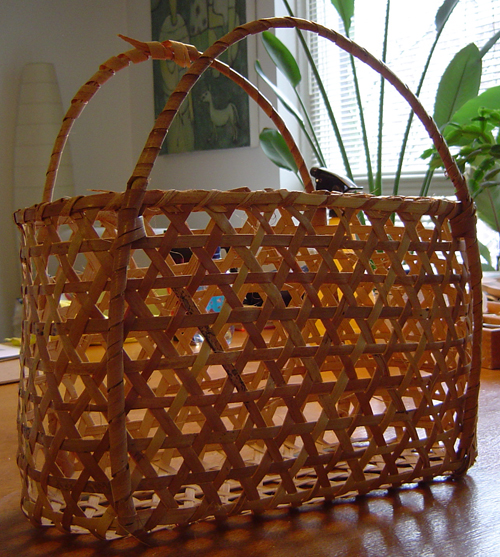
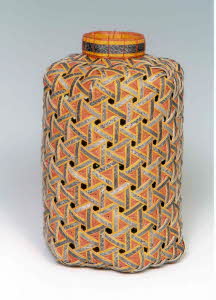
In particular I am enchanted by that South-East Asian way of weaving, which is called hexagonal weave. Here are two photos of it: a shopping bag I bought in Cambodia and a vase woven in the same technique (but in a denser way) out of paper strips made by an American artist who specializes in contemporary basketry and fiber art: Jackie Abrams. She also makes more organic forms. Since the first half of the 90’s I have been exploring paths of ceramics, but maybe I’ll do the same with basketry some day. Your weaving made me also think of weaving in the field of basketry.
There used to be a certain disdain from the art world towards the world of crafts in the 90’s. I remember the first reactions of art people when I told I was experimenting with ceramics in jewellery: the idea of glossy glazes and the prejudice it would look like folk craft or something of the sort. In the 21st century that seems to have changed. Now there is a genuine interest in crafts and their techniques; and now arts and crafts are mentioned in one breath, also in titles of prestigious international exhibitions. I know from people working in the world of ceramic art and design that they really had to fight, and still are, to have their work regarded as art instead as just ‘(folk) craft’, ‘pottery’. In a similar way we are doing that with our jewellery. When in academy I heard some students of the painters department -the real artists of course- talk about the jewellery department as ‘the earring club’  ! !
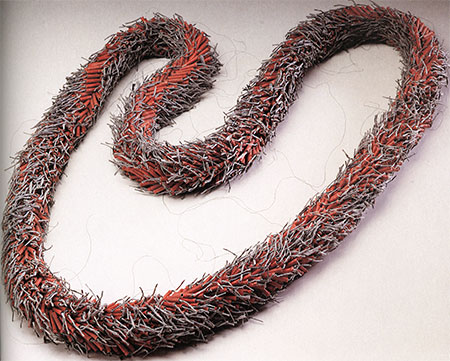 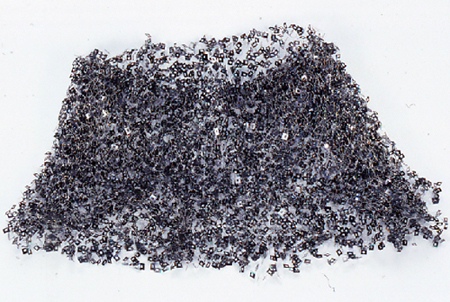
Also your ‘textile’ technique of working made me think of a Swiss woman that also uses an in origin textile technique to make her works with. She doesn’t weave though, but she crochets with the silver wire and she includes all kinds of ordinary non-precious materials while crocheting to build impressive and beautiful collars and necklaces: pill strips, watch wheels, fire crackers. You probably know her work: Verena Sieber-Fuchs, she is well-known.
Will start preparing some food now. Till soon. Peter.
|
|